Introduction: The Dual Nature of a Billion-Dollar Industry
Affiliate marketing is one of the most vibrant industries in electronic business, with the international industry worth $17 billion in 2023 and affiliate marketing expenditure projected to stand at about $13 billion in 2024. This performance-based marketing model has evolved from a niche strategy to a mainstream revenue channel, with statistics showing that 16% of all online orders in the United States are made through affiliate marketing. Beyond direct sales, 83% of marketers utilize affiliate marketing to raise brand recognition, demonstrating its dual function as both a direct response and brand awareness channel.
To businesses, content creators, and marketers, affiliate marketing poses a multifaceted tapestry of substantial opportunities counterbalanced by meaningful challenges. This in-depth analysis explores both aspects of affiliate marketing based on industry statistics, success cases, and strategic models to offer a balanced view of how to navigate this dynamic ecosystem effectively in 2025 and beyond.
The Affiliate Marketing Ecosystem: How Performance-Based Partnerships Work
Affiliate marketing is a performance-based model of revenue sharing in which independent marketers (affiliates) receive fixed payments only upon completion of certain actions, whether sales, qualified leads, or other qualified actions. This system has three integral participants:
- Merchants/Advertisers: Companies with products or services for sale
- Affiliates/Partners: Independent marketers who promote these products
- Consumers: Targeted consumers who perform desired actions
The procedure generally starts with an affiliate signing up for a merchant’s program and being assigned specific tracking links. When customers click on these links and perform a stated action (purchase, sign-up, etc.), an affiliate earns a definite commission. Different models of compensation have been developed to suit different business needs, such as Pay-Per-Sale (PPS), Pay-Per-Click (PPC), Pay-Per-Lead (PPL), and recurring commission schemes for subscription-based products.
The Substantial Benefits of Affiliate Marketing: Opportunities for Strategic Growth
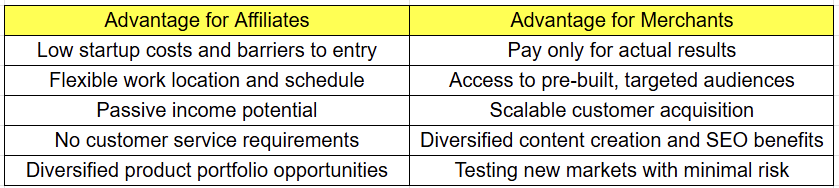
- Unparalleled Cost Effectiveness and Risk Reduction
The results-oriented character of affiliate marketing is its biggest financial benefit. Companies only pay for realized results, whether sales, leads, or other tangible actions. This model significantly minimizes marketing risk in comparison to conventional promotion where compensation is demanded irrespective of performance. Studies show companies can expect to recoup an average of $6.50 per dollar of investment in affiliate marketing, ranking one of the lowest-cost channels of action. This correspondence of marketing expense and real revenue is especially useful for companies with lean operating budgets or those that must grow without the assistance of additional funding. - Pre-Existing, Targeted Audiences Access
Affiliates provide an existing audience that they’ve spent years cultivating and growing. When they endorse a product, merchants gain immediate access to pre-existing, trust-based communities immediately. This benefit is not merely exposure—it’s access to consumers who actively care about the opinion and recommendation of the affiliate. Good affiliates with highly engaged audiences tend to produce more qualified leads than decades of social media marketing, simply because they’re tapping into existing relationship capital. - Scalable Growth with Beneficial Cash Flow Dynamics
In contrast with marketing channels involving huge initial investment, affiliate marketing falls in line with good cash flow management. Commission payments come after businesses have already obtained customer payment, so marketing expenses are always guaranteed by actual revenue. Such financial setup allows businesses to scale customer acquisition in a predictable manner while ensuring financial stability. When businesses expand, they can hire more affiliates systematically to build more reach and generate more sales, thus establishing a virtuous cycle of expansion. - Diversified Marketing Without Direct Investment
Every affiliate uses different promotional tactics, building a natural marketplace of channel testing at no cost to the merchant. Some are great at elaborate YouTube tutorial creation, while others specialize in SEO articles, email campaigns, or social media interaction. This variety creates numerous marketing experiments in parallel, giving useful feedback about what messages and channels best suit a product without channel testing investment internally. - Passive Income Potential and Flexible Entrepreneurship
The model is valid passive income potential for affiliates through the “earn while you sleep” syndrome. With content created and affiliate links in place, they can earn commissions on a perpetual basis with very little constant effort. This affords fantastic flexibility—affiliates are able to work from any location with an internet connection, create their schedules, and develop businesses that support their life circumstances instead of controlling them. The minimal startup costs and low barrier to entry compared to conventional businesses make it within reach of a wide scope of entrepreneurs.
Table: Key Advantages for Affiliates vs. Merchants
The Substantial Challenges of Affiliate Marketing: Copping With Fancy Risks
- Brand Control and Reputation Risks
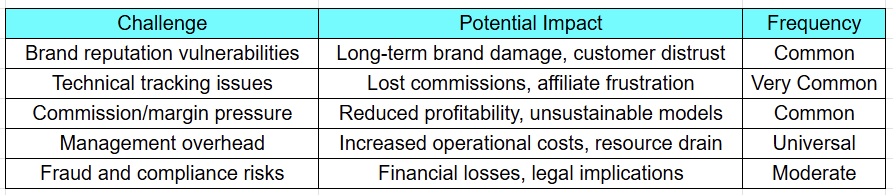
As companies invite affiliates to promote their brands, they necessarily relinquish some control over how their products are described and promoted. Some affiliates might employ deceptive or aggressive selling techniques to push sales, harming hard-won brand reputation. The decentralized distribution of affiliate promotions makes problematic content spread like wildfire across a variety of platforms, and by the time negative issues are realized, reputational harm might be accomplished. Even though companies can have promotional guidelines in place, policing compliance among hundreds or thousands of affiliates is always a challenge. - Technical Complications and Tracking Integrity
The “hidden” expenses of affiliate marketing typically arise in the upkeep of trustworthy tracking systems. Tracking can be disrupted by site updates, cookie limitations, browser types, ad-blockers, or technological errors, resulting in lost commissions and irritated affiliates. The industry still struggles with attribution issues, especially as privacy laws stiffen and browsers begin to eliminate third-party cookies. Reliable attribution across devices and touchpoints demands advanced tracking technology and ongoing system monitoring. - Commission Competition and Margin Pressure
With growth in popularity of affiliate marketing comes the increased commission rate competition that perpetuates margin pressure. Companies are often pressured to increase commissions just to keep top affiliates from going elsewhere, where better pay is available. Moreover, affiliates tend to compete based on price, which results in a battle to the bottom that compresses merchant margins on both sides. Customers obtained via discount-oriented affiliates generally tend to have lower lifetime values and increased churn rates when presented with superior offers elsewhere. - Relationship Management and Administrative Burden
Operating a successful affiliate program involves extensive ongoing work that most companies do not appreciate at the planning stage. The overhead of administration entails constant recruitment of affiliates (to replace inactive partners), creation of promotional materials, monitoring of performance, resolving questions, and payout processing. Absent good systems, handling hundreds of affiliate relationships can take a lot of staff time. Furthermore, the affiliates themselves experience high levels of competition, where success involves significant patience, commitment, and strategic adjustment before realizing significant income. - Fraud Vulnerabilities and Compliance Issues
The performance basis of affiliate marketing invites undesirables using methods from cookie stuffing to self-referral and other commission manipulation tactics. Affiliates may also bid on brand terms in paid search, essentially making merchants pay for customers who would have otherwise converted in direct channels. Advanced fraud tactics need focused monitoring tools and round-the-clock guard to avoid money losses. Moreover, compliance with changing FTC policies and local advertising codes of practice for a scattered affiliate network is an ongoing compliance issue.
Table: Frequency of Common Affiliate Marketing Challenges and Effect
Success Stories: Top Performing Affiliate Marketer Profiles
Pat Flynn: Openness and Value Generation
Pat Flynn established his Smart Passive Income empire after losing his architecture position in 2008. He made a blog initially designed to provide study notes for a licensing examination into a multi-million dollar enterprise. Flynn generated $7,008.55 from his initial month of affiliate marketing, which he refers to as life-altering. By 2014, his earnings exceeded $3 million per year. His philosophy lies in serving audiences, cutting through industry noise, and delivering real value—principles that have made him one of the most respected transparent voices in the industry.
Zac Johnson: Breaking Barriers with Persistence
With experience spanning more than two decades, Zac Johnson started affiliate marketing as a high school student in 1995. His initial success was achieved by way of an online celebrity directory with Amazon affiliate links to film and music that raked in six-figure revenues during his high school years. Johnson currently makes an estimated $1 million a year from affiliate marketing while imparting his knowledge to others via his blogs Blogging.org and ZacJohnson.com. His story is an inspiration to the power of persistence, flexibility, and ongoing experimentation in changing digital platforms.
Matt Diggity: SEO-Focused Strategy
Matt Diggity shifted from electrical engineering to affiliate marketing after burnout due to 60-hour work weeks. He found the power of SEO and started creating websites every evening after work from his corporate position. His companies today earn a combined $400,000 in monthly revenue with an estimated net value of $3 million. His success is due to dominating search engine optimization strategies and using analytical methods towards content strategy and link building.
Kirsty McCubbin: Paid Traffic Mastery
Kirsty McCubbin, who started out as an SEO expert in 1999, generates 85% of her income from pay-per-click (PPC) advertising using Google AdWords, Bing, and Yahoo. Her “Create traffic first. Monetize later” philosophy revolves around the development of audience reach prior to optimizing. This reflects that diversified traffic generation methods can thrive in affiliate marketing when implemented with professionalism and strategic endurance.
Strategic Model: Optimizing Gains While Reducing Negatives
For Merchants: Creating Long-Term Affiliate Programs
Enact Strict Affiliate Screening: Choose affiliates whose content, values, and audience correspondence complement your company instead of solely going after those with the most followers. Perform due diligence to check for domain authority, engagement metrics, and advertising habits prior to partnership approval.
- Implement Segmented Onboarding and Assistance: Establish detailed onboarding procedures, including program policies, commission payment structures, and optimal promo strategies. Offer affiliates brand-aligned promo materials to ensure messaging harmony while lessening their content creation load.
- Set Definitive Communication Protocols: Have consistent contact by way of personalized communications, feedback channels, and performance reports. Put in place formal processes for gathering affiliate input on what works with their audiences, then apply the input to optimize campaign tactics.
- Balance Competitive Commissions with Profitability: Study normal commission rates in your market and price your offers competitively while keeping sustainable profit margins. Consider the tiered commission structures that reward star performers without compromising overall profitability.
- Diversify Your Affiliate Portfolio: Refrain from being overly dependent on a handful of top-performing affiliates by developing a diversified portfolio across various niches and audience groups. This helps disperse risk and identify emerging opportunities for growth within various demographic groups.
For Affiliates: Creating Sustainable Income Streams
- Choose Products by Strategic Alignment: Select affiliate programs that link to your niche, audience interests, and your values. Check program reputation, commission rates, and terms before joining, and focus on products you have personally used and endorse .
- Prioritize Audience Trust by Being Transparent: Disclose affiliate relationships openly and give honest reviews with both positive and negative points about products. Genuine trust develops long-term relations that beat short-term conversion tricks.
- Diversify Traffic Sources and Revenue Streams: Leverage multiple-channel approaches that include SEO, social media, email marketing, and possible paid traffic. Diversification shields businesses from algorithm updates and platform policy changes that may affect single-channel reliance.
- Emphasize Content Quality and Value Creation: Create robust, high-value content covering specific audience pain points and questions. Better content usually excels at engagement as well as conversion rates compared to generic promotional content.
- Enforce Strict Testing and Optimization: Regularly test various content types, promotion methods, and positioning using A/B testing. Scrutinize performance metrics to determine top-performing strategies and double down on success while phasing out low-performing tactics.
The Future of Affiliate Marketing: Emerging Trends and Evolution
The affiliate market keeps moving towards increasing complexity with a number of trends driving its future evolution. Integration of artificial intelligence is making partner screening, performance measurement, and content refinement more efficient. Multi-touch attribution models are increasingly taking over last-click attribution, enabling more equitable compensation for influencers across the customer journey. Mobile-first experiences and social commerce integrations are creating reduced paths to purchase, especially through sites such as TikTok and Instagram.
At the same time, ongoing phase-out of third-party cookies is fueling adoption of privacy-first tracking technologies and greater focus on first-party data gathering. These trends suggest a more evolved, transparent, and strategically integrated future for affiliate marketing, with quality content and true partnerships more and more prized over strictly transactional relationships.
Conclusion: Strategic Equilibrium in a Changing Industry
Affiliate marketing is a multifaceted field of major opportunities weighed against substantive challenges. For companies, its pay-for-performance nature provides unmatched cost-effectiveness and expandable growth, but necessitates close monitoring of brand reputation, technical infrastructure, and partner relationships. For affiliates, it offers genuine passive income opportunity and adaptive entrepreneurship, but requires tactical patience, ongoing evolution, and genuine audience connection.
The success stories of high achievers show that sustainable achievement comes from delivering real value and not being after short-term optimization strategies. As the market moves toward increased sophistication and transparency, individuals focused on authentic partnerships, diversified strategies, and audience trust will be best equipped to leverage affiliate marketing’s real advantages while successfully working through its inherent limitations.
Whether you’re a merchant looking to start an affiliate program or a prospective affiliate starting an online business, the structure outlined here is a guide to executing strategically. Knowing the pros and cons ahead of time will allow you to make informed choices that fit your business goals, principles, and ability for sustained program management.